
“Why use Excel to analyse data? And when is it time to take the next step?”
Excel is one of the most widely used tools in the world for managing and analysing data. Its simplicity and familiarity make it the first choice for millions of professionals.
But when the data grows in volume and complexity, Excel can become a limitation.
In this article we will see why Excel is still useful , but also when it is worthwhile moving on to more advanced solutions such as Power BI and Microsoft Fabric .
Let’s start here: imagine you have a large database with millions of rows of transactions, customers, products, and performance metrics.
At this point we need to ask ourselves: Is Excel really the right tool for analysing large volumes of data?
Why Excel is still important
- Accessibility and widespread use : Everyone knows Excel, it’s straightforward and doesn’t require complex training.
- Flexibility : Excellent for quick analyses, prototypes and customised models.
- Integration : Easily connects to common data sources and allows for customised calculations.
The limitations of Excel
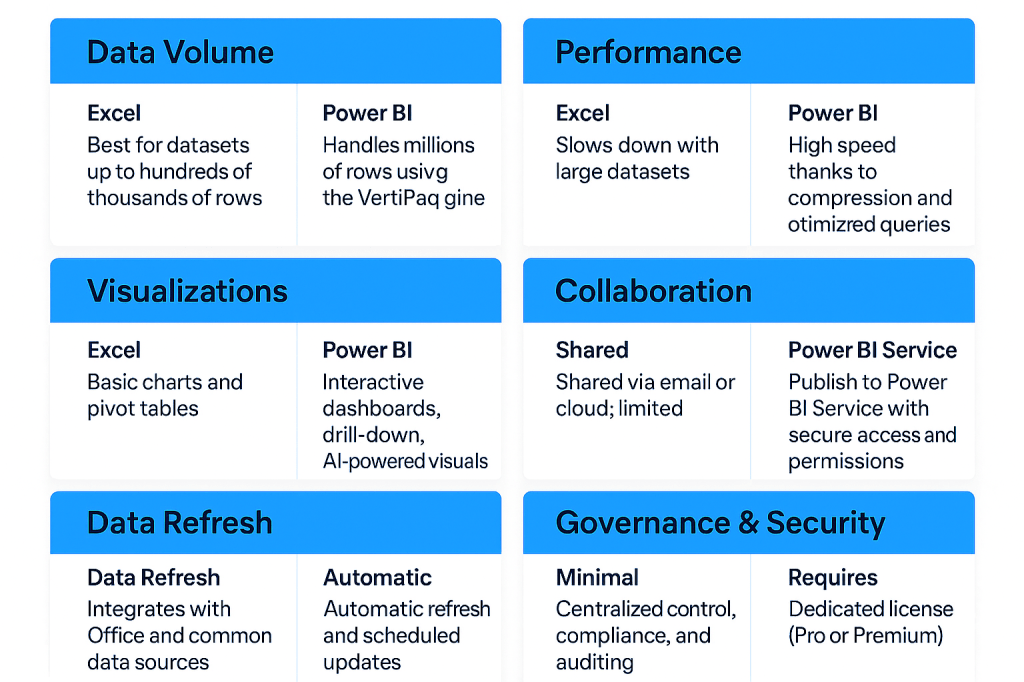
- Performance : When the data exceeds several hundred thousand rows, Excel slows down.
- Collaboration : Files shared via email or network are not very secure and difficult to manage.
- Scalability : It’s not designed for analysis of millions of records or for complex BI models.
When to make the leap to Power BI and Fabric
- Big Data : If your datasets exceed a million rows, it’s time to think about Power BI.
- Automation and AI : Fabric integrates advanced tools for pipelines, data lakes and predictive models.
- Governance and Security : With Fabric and Power BI you have centralised control, versioning and compliance.
Best practice
To successfully move from Excel to Power BI or Fabric, I recommend that you:
- Invest in ongoing training, so you gain the necessary skills and keep up to date with new developments.
- Involve the IT team to ensure proper integration and secure data management.
- Integrate the new tools gradually, starting with pilot projects and keeping Excel where needed.
- Carefully assess business needs before choosing the most suitable solution.
These simple measures help make the transition more effective and less risky.
I have been working with business intelligence tools for over 10 years. During this time I have seen how Excel has often been the starting point for many professionals: its accessibility and flexibility make it an irreplaceable tool for quick analysis and prototyping. However, as data and business needs grow, I have learned that it is crucial to recognise when it is time to move on to more advanced solutions such as Power BI and Microsoft Fabric.
The real challenge is not just knowing how to use the tools, but understanding which is most suitable for each scenario.
My advice, therefore, is never to stop in your comfort zone: experiment, update yourself and always choose the solution that enables you to turn data into real value for your business.
Excel is an excellent starting point, but it should not be the end point. If you want to turn data into strategic insights, Power BI and Microsoft Fabric are the future of analysis.
Boom, done 💣!
Follow me:
 BEYOND THE PLATFORMS
Leave a comment