A silent but radical change
Until yesterday, the concept of work as “professionalism” was relatively stable: you learned a trade, consolidated a set of skills, grew through experience. Stop, finished! Or almost.
Today, this dynamic is changing at a speed that no longer depends on people, but on the tools people bring with them.
The turning point is not just “AI in the company”, but personal and everyday AI : a copilot that writes, summarises, analyses, suggests, simulates scenarios and — increasingly often — helps you make better choices.
When every role, from warehouse operator to doctor, integrates a copilot, the question is no longer “what hard skills are needed?”, but: “What does it mean to be competent when intelligence is distributed between person and system?” Who becomes “stronger” thanks to AI and who, instead, risks becoming dependent on it?”
Themes and implications (including social ones)
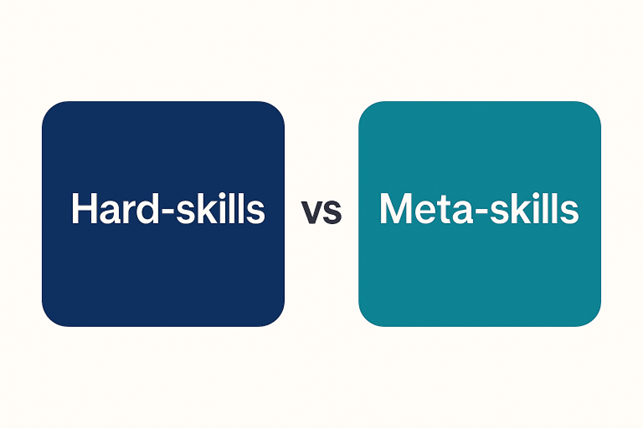
1) From hard skills to meta-skills: competence changes form
Hard skills do not disappear, but their specific weight changes . If a copilot can generate a draft analysis, a text, a plan, or a report, the difference is made by those who know how to:
- Orchestrate : choose tools, sources, methods and the order of actions;
- Ask better questions ( prompting as structured thinking , not as “tricks”);
- Evaluate and decide : verify, estimate risks, make trade-offs, take responsibility;
- Control quality : distinguish between “plausible” and “correct”;
- Turn output into impact : bring AI into processes, teams, stakeholders.
In other words: competence is no longer just “knowing how to do”, it is knowing how to direct . It is not just execution, it is direction .
And here again appears the “New Literacy” : it is not enough to know how to use AI. You need to know how to govern it. (I wrote a dedicated article which you can find here -> link)
2) The AI “competence gap”: passive vs integrated
Here a silent fracture arises:
- Passive use : “write me a text”, “make me a table”, “write me an email”. AI becomes an output printer.
- Integrated use : AI is inserted into a flow: data → context → objective → iterations → verification → decision → traceability.
The competence gap is not between those who use and those who do not use AI. It is between:
- those who use it as a shortcut
- those who use it as a method amplifier .
Social impact (often underestimated)
This gap translates into:
- new inequalities : not economic, but cognitive and organisational;
- career polarisation : a few “orchestrators” grow a lot, many “assisted executors” remain stuck;
- risk of de-skilling : if I always delegate, I lose critical thinking and the ability to build from scratch;
- “autopilot” effect : increase in perceived productivity, but drop in decision quality when verification is lacking.
The issue, therefore, is not just upskilling: it is justice in access to meta-skills .
3) Professionalism “in pairs”: the unit of work becomes human + copilot
We are moving from “competent person” to “competent person with competent system”.
- The person brings: objectives, context, values, responsibility, intuition, experience.
- The copilot brings: speed, memory, patterns, suggestions, simulations, generation of alternatives.
But beware: the pair only works if there are three things:
- context (reliable and up-to-date data),
- governance (rules, limits, audit),
- accountability (who signs the decision?).
If any of these elements is missing, AI becomes an accelerator… of chaos.
4) Redefined professions: concrete examples (with “new job shapes”)
a) Project Manager → Orchestrator of complexity
The PM is no longer a “Gantt manager”, but:
- director among people, constraints, risks and information;
- capable of using the copilot for: minutes, risk log, stakeholder map, forecast, “what-if” scenarios;
- responsible for the quality of decisions, not the quantity of documents produced.
Key meta-skill: decision-making under uncertainty + “multi-stakeholder” communication.
b) Data Analyst → Translator between business and models
The data analyst does not “make charts”. They:
- define the problem (which is half the solution);
- verify sources and biases;
- build narratives based on evidence;
- integrate AI for rapid prototypes, but with methodological rigour.
Key meta-skill: data literacy + reasoning + quality control (validation, replicability, traceability).
5) The human side: identity, status and fear of being “less useful”

Every technological revolution brings with it an identity revolution:
Here strong social themes come into play:
- anxiety about replaceability (even when the goal is to augment, not replace);
- loss of professional self-esteem ;
- new invisible hierarchies (those who know how to orchestrate dominate, others execute);
- generational tension (young AI natives vs seniors who fear having to “start over”).
The answer is not to deny nor romanticise. It is to design transitions:
- reverse mentoring (junior → senior on AI practices; senior → junior on context and judgment),
- safe spaces for experimentation,
- value metrics tied to impact, not just output production.
6) The competence of the future: “knowing how to verify”
If I had to choose one meta-skill above all? Verification.
To verify means:
- check sources and data;
- test hypotheses;
- ask for counter-arguments;
- document reasoning;
- know how to say “I don’t know” and stop.
This is where the “augmented” professional is distinguished from the “assisted” professional.
Professionalism does not die: responsibility changes
Work is not becoming simpler. It is becoming faster , and therefore more risky if methodology is lacking.
AI copiloted does not eliminate competence: it shifts it.
From manual skill to intentionality.
From performance to direction.
From static knowledge to the ability to learn continuously.
The decisive question today is not “what can a person do”, but: how does one think, how does one decide, how does one verify and how does one build trust in the systems one uses.
In your work, is AI a shortcut or a method amplifier?
Contact me.
Boom, done 💣!
Follow me:
 BEYOND THE PLATFORMS
Leave a comment