
In the world of Power Platform, three technologies are converging to transform the way we build digital solutions: Dataverse, Model Context Protocol (MCP), and Copilot Studio. Each is a powerful tool on its own. Together, they are the key to creating intelligent, contextual, and governed experiences.
Do you know what MCP is?

A while ago, I wrote an article about MCP (Model Context Protocol), which you can find here:
MCP in Copilot Studio – BEYOND THE PLATFORMS
The Model Context Protocol (MCP) is a standard that allows you to create secure and scalable AI extensions. In this article, I explain how MCP enables developers to build modular functionalities for Copilot Studio agents, making them more powerful, contextual, and personalised.
In other words:
Imagine you have a robot assistant helping you with your homework. But if it doesn’t know which class you’re in, which subjects you study, and what kinds of exercises you prefer… how can it really help you?
The same thing happens in technology. We have intelligent assistants, like those created with Copilot Studio, but they often don’t know what we’re talking about. That’s why we need something to provide them with context. That something is called MCP – Model Context Protocol.
The Copilot Studio – MCP – Dataverse Triangle
The solution: context, structure, and conversation
Dataverse is the data engine of Power Platform. It allows you to model entities, relationships, and business logic in a structured, secure, and scalable way. It is the foundation upon which intelligent applications are built.
Model Context Protocol (MCP) is the protocol that connects data models to conversational context. Thanks to MCP, assistants created with Copilot Studio can understand the entities, relationships, and rules defined in Dataverse. They don’t just generate responses—they generate them in an informed and coherent manner.
Finally, Copilot Studio is the tool that enables the creation of customised AI assistants, capable of interacting with users, systems, and data. With MCP, these assistants become context-aware, and therefore truly useful.
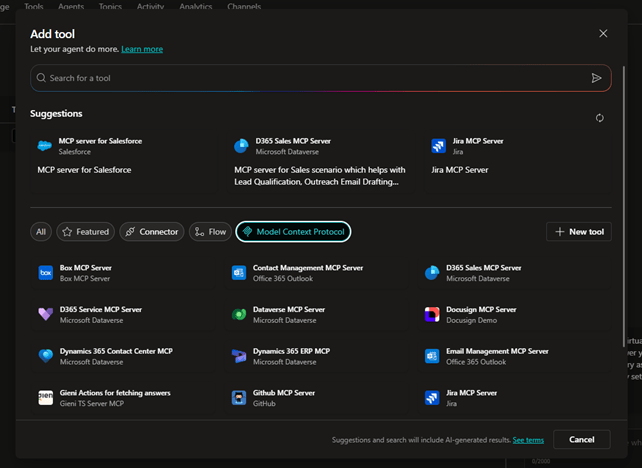
The problem: isolated data, generic AI, fragmented experiences
Organisations today face three challenges:
- Data are distributed in silos, making them hard to model and query
- AI assistants are often generic, unable to understand business language
- Applications don’t communicate with each other, and context is lost across systems
The result? Solutions that appear modern, but don’t actually solve the real problems.
The benefits for professionals and organisations
- Model data once in Dataverse and reuse it everywhere
- Create AI assistants that speak the language of business
- Automate processes with intelligent and contextual conversations
- Centralised data governance
- Smoother and more personalised user experiences
- Reduced operational workload thanks to conversational automation
Guaranteed security and control
- Dataverse protects data with roles, permissions, and audit trails
- Copilot Studio allows you to define access and behaviour rules
- MCP ensures that the AI operates only within the defined context, preventing incorrect or out-of-scope responses
Context is the new code
In the future of Power Platform, the real competitive advantage will be the ability to model context, govern data, and engage in intelligent dialogue. Dataverse, MCP, and Copilot Studio are the tools to build this future.
At this link, I will show you how to connect Dataverse’s MCP to Copilot Studio.
Boom, done 💣!
Follow me:

 BEYOND THE PLATFORMS
Leave a comment