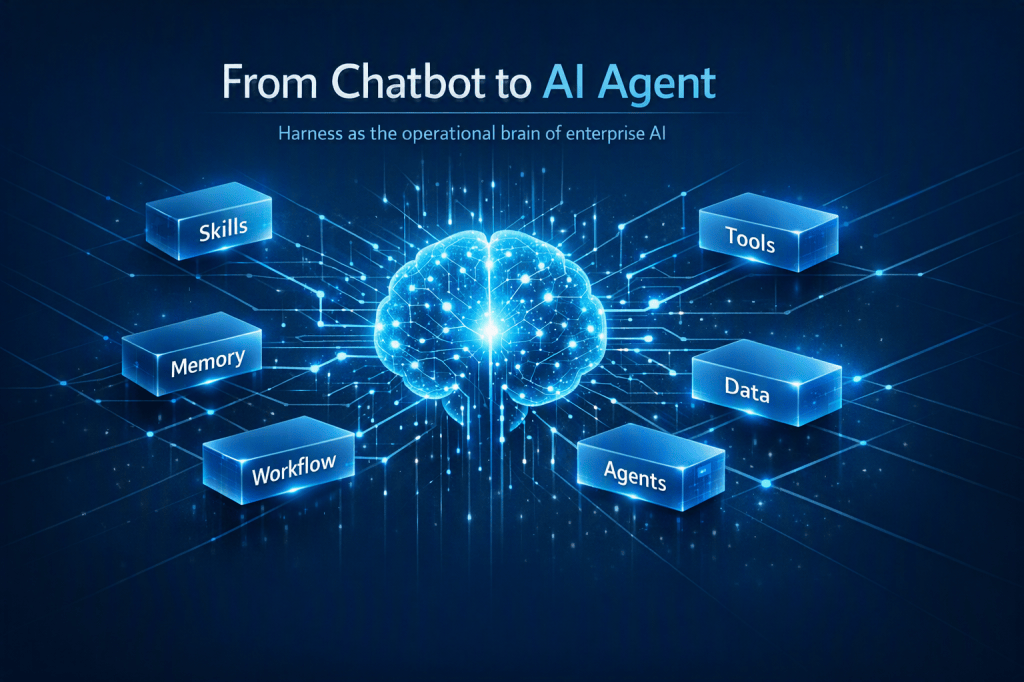
Why the new GitHub Copilot Harness is not just another feature, but a paradigm shift in how we design enterprise AI agents.
| Quick summary: Microsoft is moving Copilot Studio from the chatbot-with-workflows paradigm to the agentic platform paradigm. You no longer design only conversational paths: you design capabilities, tools, memory, and specialized agents that collaborate to achieve an objective. |
The right question is not “what is a Harness?”
The right question is: why did Microsoft feel the need to introduce a new way to build and run agents?
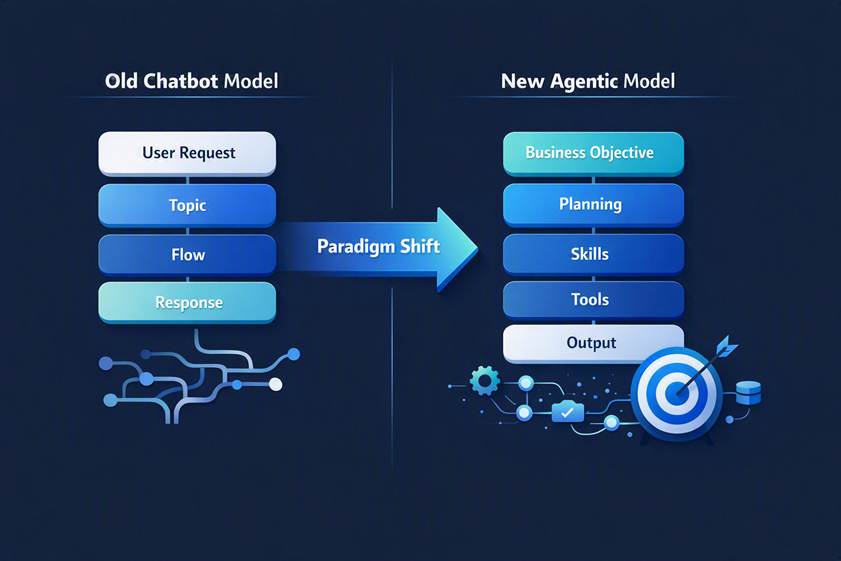
To answer that, we need to take a step back. Until now, many agents built in Copilot Studio worked in a fairly predictable way: the user wrote something, the agent identified a topic, a topic was triggered, a flow was executed, and a response arrived.
This approach works well when the process is clear, repeatable, and highly controlled. But it starts to show its limits when the user is not asking for a simple answer, but for a complete piece of work.
The limitation of older agents
Imagine a request like this: “Analyze all invoices received this month, compare them with purchase orders, identify any anomalies, and generate a report.”
Here, we are not asking for an answer. We are asking the agent to carry out a process: find documents, read data, compare sources, choose the right tools, handle possible errors, and produce a final output.
Older models were mainly designed to follow procedures. The new model is designed to achieve objectives.
What a Harness really is
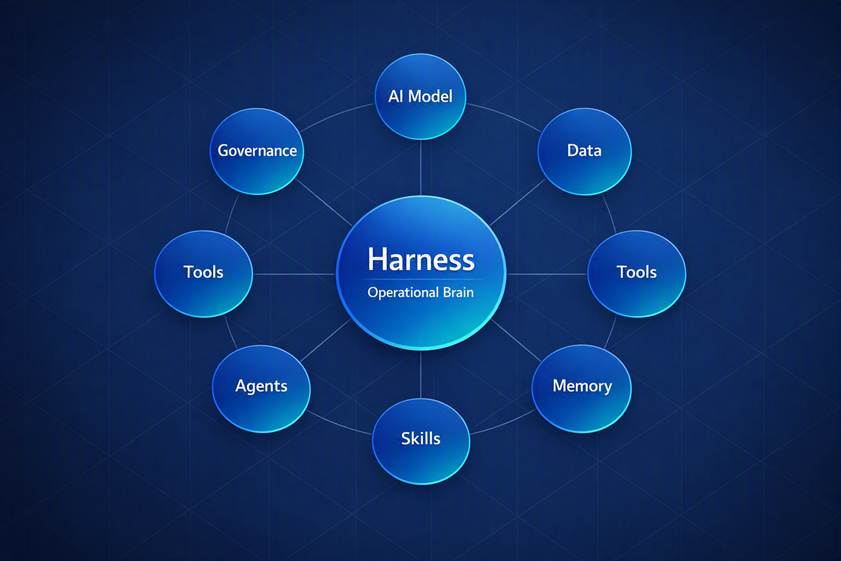
The simplest way to understand it is this: a Harness is the system that enables the agent to reason, plan, choose the right tools, use the available information, and adapt during execution.
It is not just the AI model. It is not just the tool. It is not just the workflow.
It is the layer that brings together the model, data, tools, memory, skills, and other agents. In practice, it is the operational brain that decides how the agent should work to reach the result.
From “how to do it” to “what to achieve”
In the old approach, we told the agent how to work: if A happens, do B; if the user writes X, go to topic Y; if data is needed, run that flow.
In the new approach, we can tell the agent what we want to achieve. The Harness will then build the operational plan, choose the capabilities to use, and orchestrate the available tools.
This is the real difference: we move from a step-based model to an objective-based model.
The three Copilot Studio Harnesses
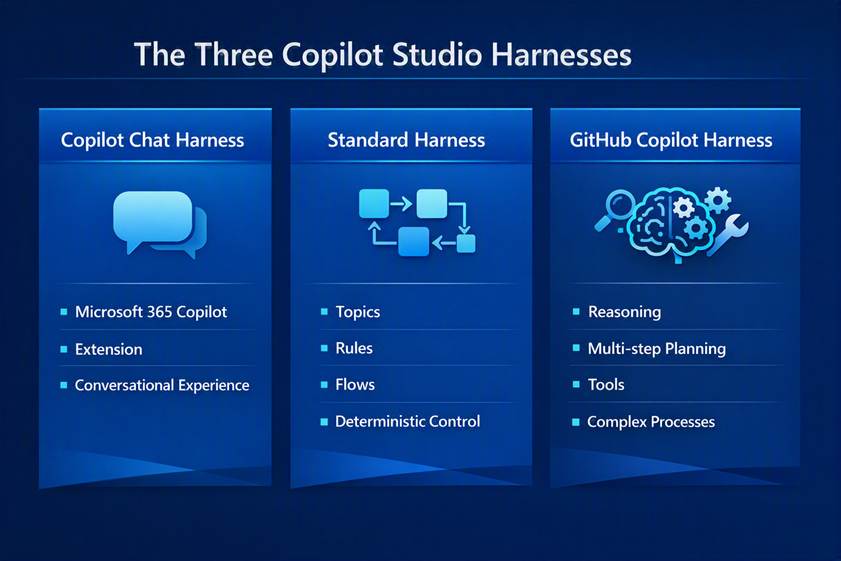
Microsoft currently distinguishes three main Harness families: Copilot Chat Harness, Standard Harness, and GitHub Copilot Harness.
The Copilot Chat Harness is designed to extend experiences connected to Microsoft 365 Copilot. The Standard Harness is the model closest to classic Copilot Studio, with topics, rules, flows, and more deterministic behaviors.
The GitHub Copilot Harness, on the other hand, is the new engine designed for more complex, multi-step activities, advanced reasoning, tool usage, documents, and more articulated processes.
Why the GitHub Copilot Harness matters
The GitHub Copilot Harness represents the most interesting shift because it brings a more agentic model into Copilot Studio. The agent does not simply respond: it can plan, use tools, manage intermediate steps, and adapt if something changes.
This opens scenarios much closer to real business processes: finance, HR, procurement, operations, reporting, advanced customer service, project management, and many other areas where a textual answer is not enough.
The point is not to have a smarter chatbot. The point is to create a digital collaborator capable of carrying out operational work.
Skills change the way we design
In the new model, the concept of Skill becomes central. A Skill can be seen as a reusable capability of the agent.
Before, we thought in terms of topics: subjects, triggers, decision branches, and flows. Now we need to start thinking in terms of capabilities: analyzing KPIs, approving an invoice, verifying a customer, creating a report, preparing a communication.
The agent no longer simply looks for the correct topic. It chooses the most suitable capability to achieve the requested objective.
The concrete benefits
More flexibility: Agents can adapt better to less structured requests and more complex scenarios.
Better ambiguity management: The user does not necessarily have to use the perfect sentence or follow a predefined path.
More powerful orchestration: An agent can coordinate data, tools, workflows, skills, and other agents within the same process.
End-to-end processes: Not just answers, but more complete operational activities, with multiple steps and concrete final outputs.
A new design model: We move from designing conversations to designing capabilities.
The potential drawbacks
Less predictability: When an agent reasons and plans more autonomously, validation requires more attention. Flexibility increases, but so does the need to thoroughly test behaviors.
A new design mindset: Those coming from the classic model must avoid a one-to-one migration. It is not enough to turn topics into skills: the agent architecture must be rethought.
Governance becomes more important: More tools, more data, more memory, and more autonomy require clear policies, correct permissions, and traceability of actions.
Cost control: The GitHub Copilot Harness model uses a consumption-based approach through Copilot Credits. This should be considered during enterprise design and adoption.
It is not always needed: For simple FAQs, rigid processes, or highly deterministic scenarios, the Standard model may still be the most sensible choice.
My take
I believe that over the next few years, we will see the concept of the enterprise chatbot, as we have known it so far, gradually shrink.
Companies will no longer ask only: “Can we build an assistant that answers questions?” They will increasingly ask: “Can we build an agent that does this work for us?”
And that is exactly the direction Microsoft is pushing toward with the new Harness: from chatbot to digital collaborator, from conversation to process, from response to execution.
Beyond The Platforms takeaway
The real value of AI is not having a smarter chatbot.
The real value lies in having a system capable of understanding an objective, planning the work, and autonomously using the tools required to achieve it.
The GitHub Copilot Harness is one of the first concrete signals of this transformation within the Microsoft ecosystem.
Boom, done 💣!
Follow me:
 BEYOND THE PLATFORMS
Leave a comment