
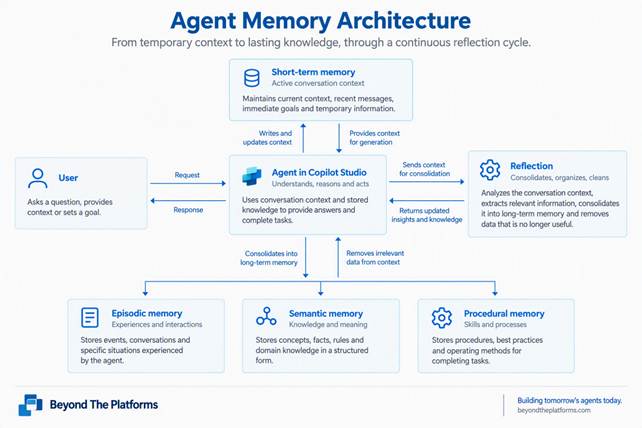
LLMs are stateless by nature. Yet our agents in Copilot Studio remember.
How does it really work, and what does it mean in practice when we build enterprise solutions?
Let’s start with a technical fact that is often taken for granted: every time a large language model receives a message, it remembers nothing.
It does not know who you are, what you asked yesterday, or what happened in the previous session. Every call starts with a clean slate.
This creates a real problem for enterprise agents.
An HR assistant that does not remember last week’s leave request, a support agent that repeatedly asks for the same contextual information, or a copilot that does not know the user has already escalated a ticket three times: these are all signs of a system that does not scale.
Copilot Studio addresses this problem with a structured memory architecture. It is worth understanding it well, because the choices we make here determine the agent’s perceived quality over time.
The two fundamental levels
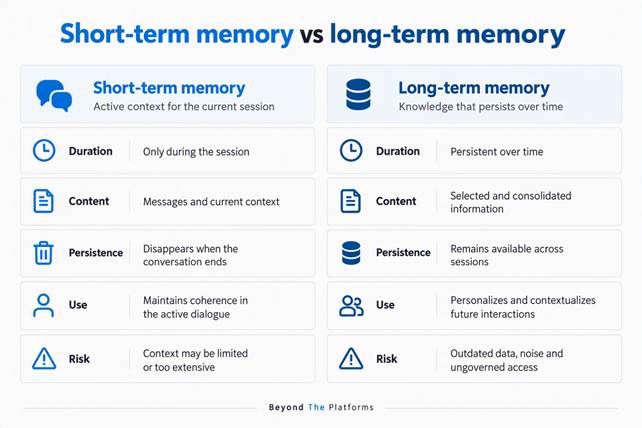
The first level is short-term memory: the context of the active conversation. Everything said during a session is available to the model for the entire duration of that session. When the session ends, this context disappears. This is the basic behavior of any conversational system.
The second level is long-term memory, and this is where the complexity increases significantly. It is not a single mechanism, but three distinct types of persistent memory.
The three types of long-term memory
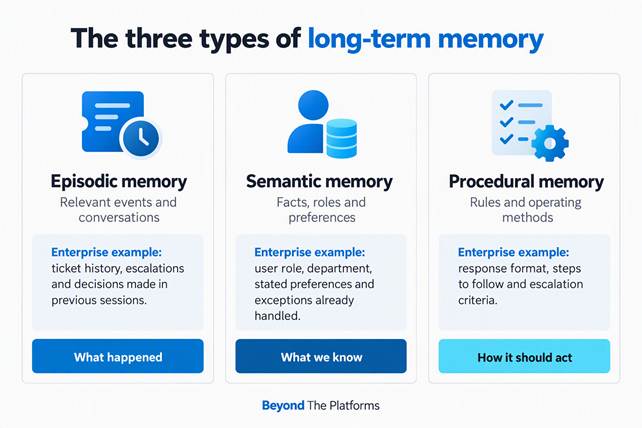
Episodic memory: the agent retains a record of specific past conversations. Not everything, but the relevant moments. This makes it possible to pick up the thread even after days or weeks.
Semantic memory: the agent accumulates facts and knowledge about the user or the domain. Who this person is, what their role is, which preferences they have expressed, and which exceptions have already been handled for them.
Procedural memory: perhaps the most sophisticated type. The agent learns how it should behave. Rules, interaction preferences, and response styles adapt over time based on implicit or explicit feedback.
The reflection mechanism
There is a fourth element that ties everything together: reflection.
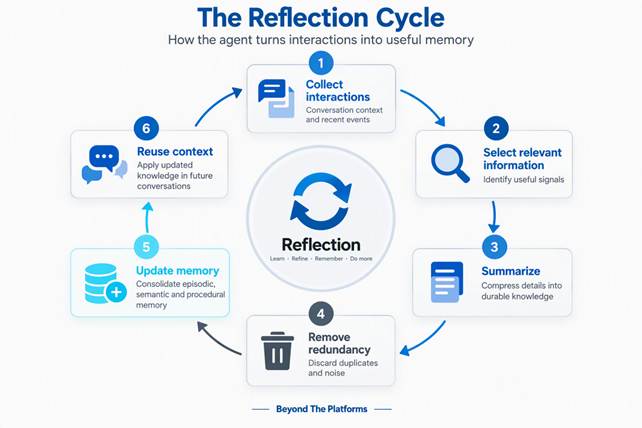
The agent does not simply store information passively. At defined intervals, it summarizes and updates its knowledge, removing redundancies and consolidating what is relevant. It is a process that brings the agent’s behavior closer to that of a colleague who learns on the job.
What this means in practice
For some of my agents, memory has radically changed the quality of the user experience.
When I return after a week, I do not have to explain my context again. The agent already knows that I have an open request, understands the context, and remembers the preferences expressed in previous sessions.
But memory is not free. It brings governance questions that must be addressed before going into production:
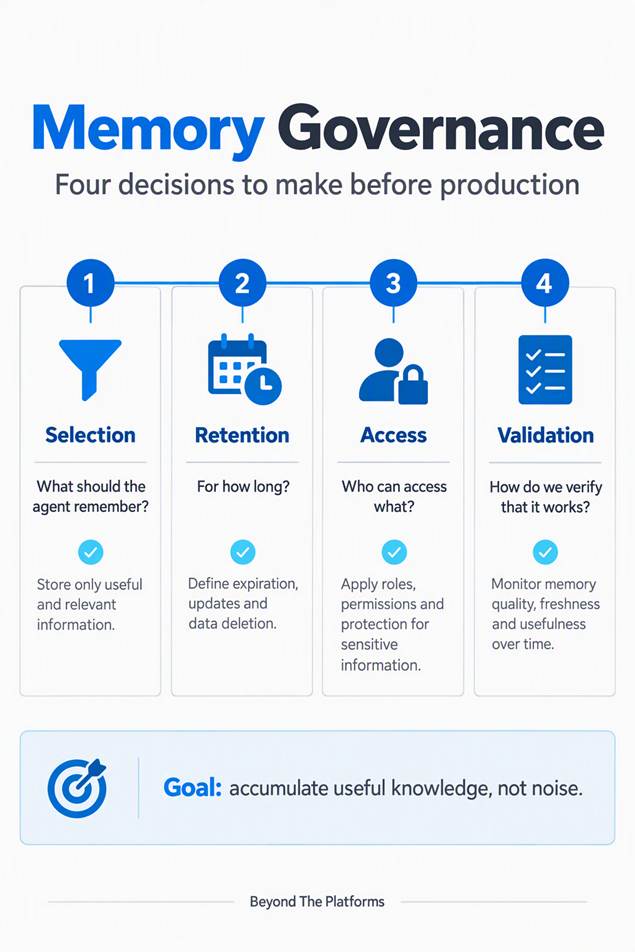
- What should the agent remember? Not everything is useful to store. Choosing what persists is a design decision, not a technical one.
- For how long? Data has an expiration date. A preference expressed two years ago may be outdated. A retention policy is required.
- Who can access what? In enterprise contexts, an agent’s memory may contain sensitive information. Access governance is an integral part of the architecture.
- How do we verify that it works? Implementing it is not enough: a validation plan is required.
The question I always ask myself before enabling memory for an agent is this: are we building a system that accumulates useful knowledge, or one that accumulates noise?
The answer almost always depends on the design choices made during the first few weeks of the project.
If you are building enterprise agents in Copilot Studio, memory is not an optional feature. It is an architectural element that must be planned from the start.
Follow me:


Leave a Reply